
The Ballot Brief helps voters understand what is on their ballot, from the top of the ticket down to nonpartisan races like mosquito control districts in St. Johns County and Manatee County, and the Palm Beach Soil and Water Conservation District, which are among our most visited pages. Voters see these names and contests on their ballot and often have trouble finding information on the candidates or what they stand for.
For each candidate, we link to their official campaign website where we find one, and summarize their bio and priorities from it. Where we cannot find a website, we cite local news sources, and where we cannot find those either, we say so clearly: that we were unable to find the information, which does not mean it does not exist, only that we could not find it. If a candidate writes in with their official site, we will add it. Write to us at admin@theballotbrief.com.
How the site is built.
Candidate names come from the lists election offices publish: certified candidate lists, sample ballots and filing records. Bios, priorities and photos come from the candidate’s own campaign site first. Where there is no site, we turn to what the candidate has published elsewhere: a statement filed for a state voters’ guide, or their answers to a local news questionnaire. Where there is neither, we cite local news coverage and name the outlet. Everything is summarized with AI tools and linked so a reader can check it against the source.
Votes in office come from the House Clerk and Senate roll-call files. Districts for a street address come from the U.S. Census Bureau’s address and district data. AI tools do the reading and the first draft; automated checks run before anything goes live; a person reviews a subset. The Post’s story on this site describes how it is used.
The pages are built for readers and for the AI assistants that read them.
Every race and every candidate has its own page, with a lookup for the full ballot. Each race page opens with the candidates’ stated priorities, the thing people use to decide. Everything is dated: each page shows when its roster was checked against the election office’s list and when each candidate’s site was last read, and a news sitemap lists the pages that changed in the last two days. A note on the use of AI sits at the top of every page, and every ballot ends with a link to the official source so a reader can verify what they see.
A ZIP code is not a district.
About 3,000 of the country’s 33,000 ZIP codes have a meaningful share of their residents in two congressional districts. About one ZIP code in 250 crosses a state line, and roughly 70 have a tenth or more of their area in a second state. No answer by ZIP alone can be exact in those places. Where a ZIP is split, our ZIP page shows both congressional races and asks for a street address, which the Census Bureau’s current boundaries resolve to one district. For 78701 in downtown Austin the page says: “ZIP 78701 spans District 10 and District 37, so your U.S. House race depends on your street address.” For 42223 at Fort Campbell, which is in both Kentucky and Tennessee, the page opens with a plain note and offers both states’ ballots.
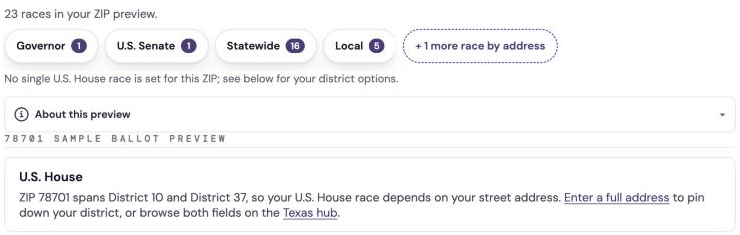
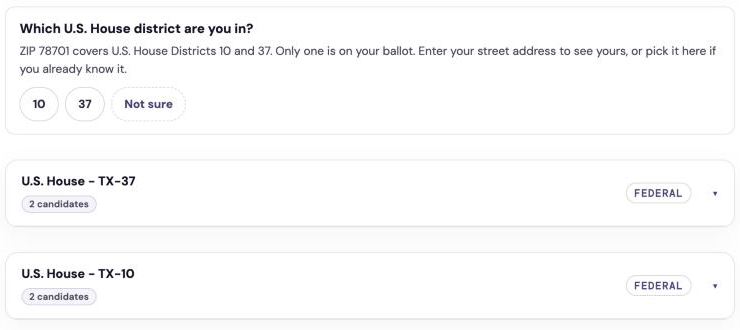
Those notes are written for both audiences. A reader sees why they are asked for an address, and an AI assistant that fetches the page reads the same sentence instead of one district’s or one state’s answer. A chatbot that drops that sentence can present one district as the answer when the page said it depends on the address, the pattern The Washington Post described when it asked six chatbots to build voter guides.
Every vote line comes from a roll call.
Vote lines on the site come from the House Clerk and Senate roll-call files, and a line from any other source does not publish. When The Washington Post checked our vote lines across the House and Senate candidates it reviewed, every line matched the official record except one, on one candidate: a Senate vote dated the day before the senator took office, written by an earlier process that summarized news coverage and official statements. It came down on October 15.
A campaign site is linked when it is the candidate’s own and current.
We link a site when it is the candidate’s own, it is for this office, and it carries 2026 content or the candidate named it on a 2026 filing. Where our search finds no site, the page says so and gives the date we looked. Since October the search also reads the website a candidate lists on their FEC committee filing and their state campaign-finance filing, which linked 52 more sites; the sentence on the remaining pages reads: “No campaign website is listed in the candidate’s FEC committee filing, and none was found as of October 15, 2026.”
Sitting officials are checked against the official roster.
A sitting member’s office, dates and committee roles are checked against the official congressional roster file every time a page is built, so a profile states what the record supports even when a campaign site is behind. Joyce Beatty’s site still describes her as an officer of the Congressional Black Caucus, a role she held in earlier Congresses; her profile carries the role the record shows.

Every priority carries its source.
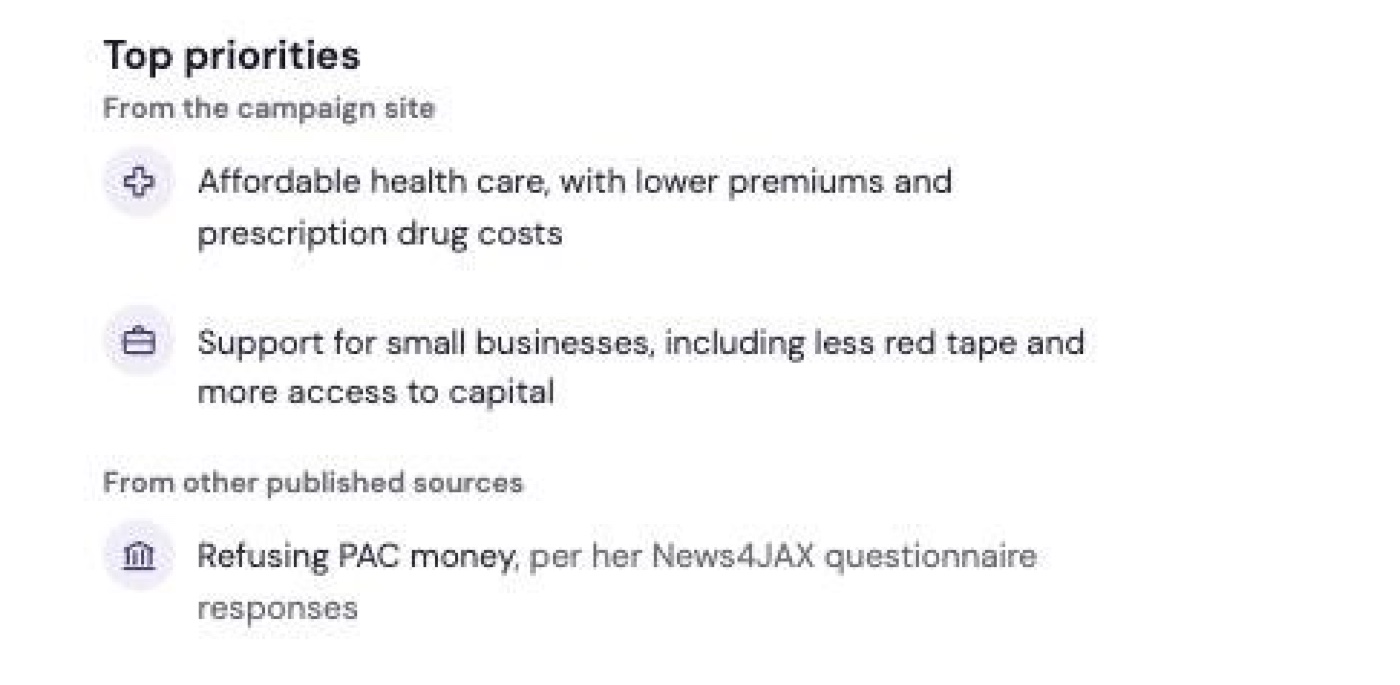
A candidate’s priorities come from the candidate’s own campaign site. Where a candidate has no site, or the site says little, we supplement with their own answers to a local news outlet’s questionnaire or with local news coverage, and we name the outlet. Each item shows where it came from. Items confirmed on the site sit under “From the campaign site”; everything else sits under “From other published sources” with the source named on the line.
District seats show your district.
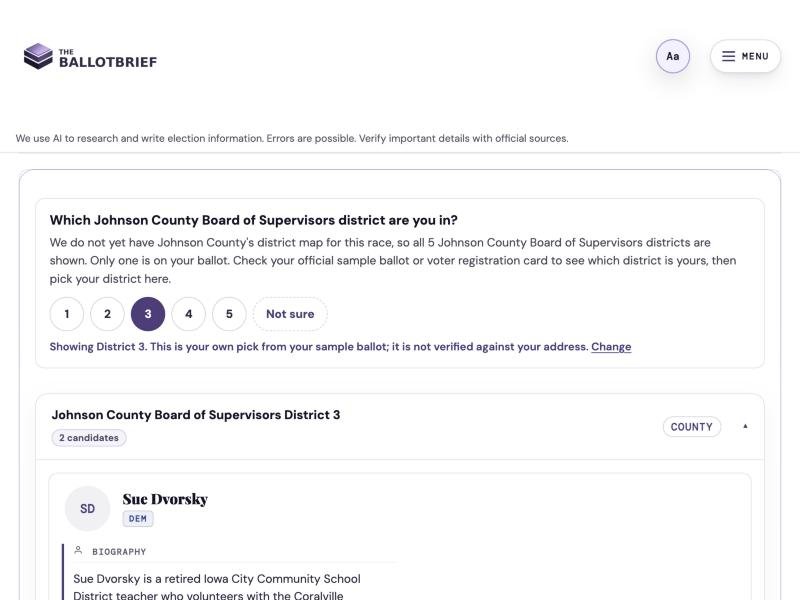
The Census gives the congressional and state legislative districts for an address, but not county-level districts: commission seats, justice of the peace precincts, school board seats. For those races a selector asks “Which [County] [district] are you in?” with a tab per district and a “Not sure” option. A pick shows that district’s candidates only, labeled as the reader’s own pick. “Not sure” keeps every district visible and points to the official sample ballot or voter registration card. Where we have loaded a county’s own district map into the site, the lookup shows the one district the address falls in, with “Your address is in District N, per the county’s district map.”
If you see something to check.
Write to us at admin@theballotbrief.com. We read every note, and a candidate who sends their official site gets it added.